
Where Low-Code Reaches Its Limits: When Custom Web Development Makes Sense
TL;DR
Where low-code works, where it reaches its limits, and when custom web development becomes the smarter long-term choice.

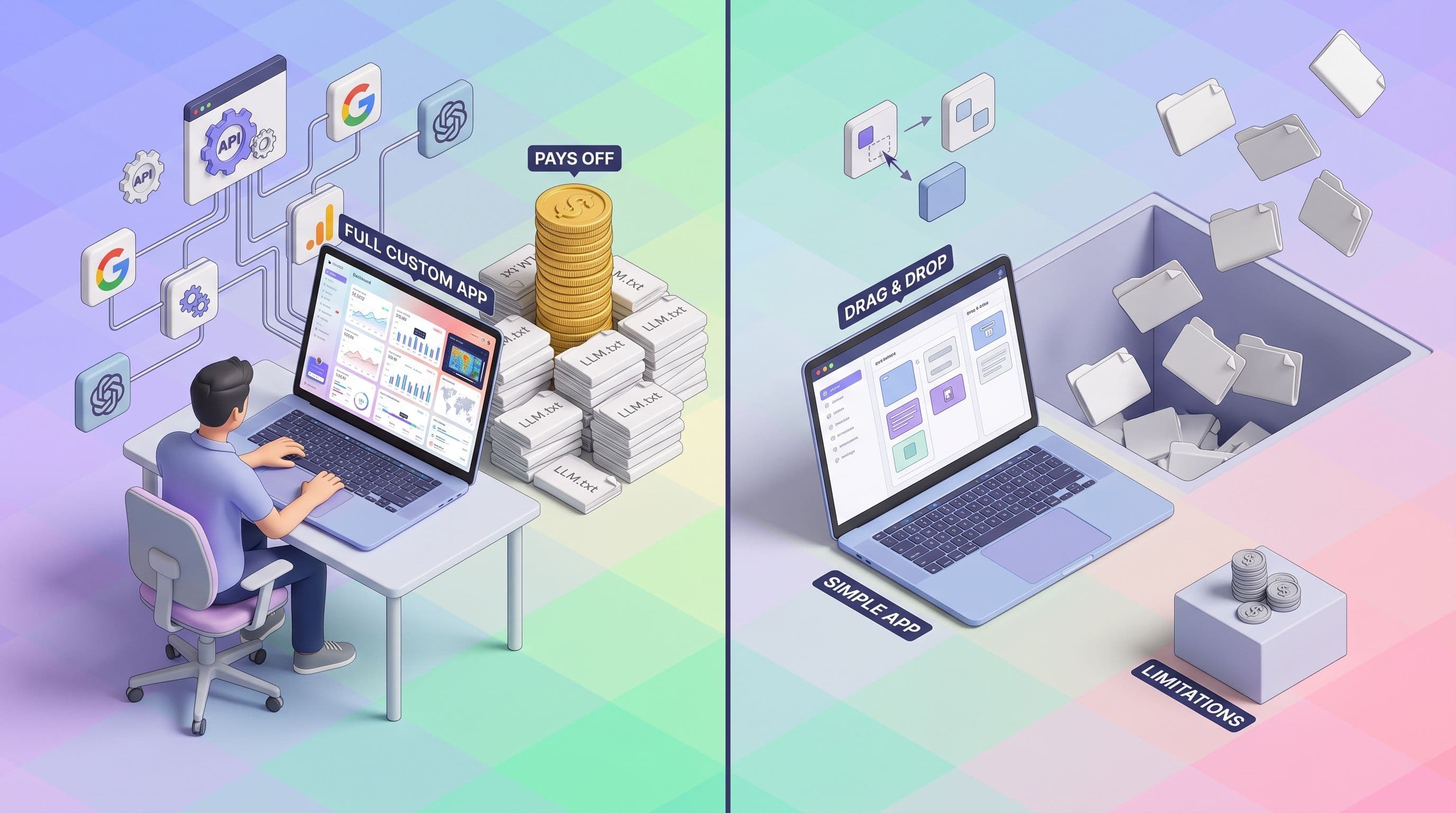
Low-code development is an excellent choice for many websites because it makes standard projects faster, more affordable, and accessible even to people without coding knowledge. However, as a project evolves and requirements become more complex, the same platform that made the initial build so easy can become increasingly restrictive. When a website requires custom functionality, complex integrations, APIs, or business logic that the platform cannot provide, professional development support can become the smarter long-term investment.
The rise of low-code and no-code platforms has changed the way websites are built.
Businesses can now launch professional websites much faster and at a lower initial cost, while visual builders, pre-built components, templates, and integrations reduce the amount of technical work involved. For standard websites such as corporate sites, landing pages, portfolios, and marketing websites, this can make low-code particularly attractive because a person without programming knowledge can often create, update, and manage a professional-looking website without needing a developer for every change. For many projects, that combination of speed, affordability, and accessibility is exactly the right approach.
But every platform has limits.
The real question is not whether low-code is better than custom development.
It is:
What happens when your website needs to do something the platform was not designed to do?
That is where having a developer involved can make all the difference.
Key Takeaways
- Low-code is an excellent choice for standard websites that need to be built quickly and efficiently.
- Low-code reaches its limits when projects require custom functionality, complex business logic, APIs, or advanced integrations.
- Custom web development provides greater flexibility and control when standard platform features are no longer enough.
- Developers can extend low-code platforms with custom code, APIs, and integrations instead of forcing the business to adapt to the platform.
- A hybrid approach can often be the smartest solution, combining the speed of low-code with the flexibility of custom development.
- The value of a developer is not building everything from scratch, but knowing when to use existing tools and when a custom solution is the better investment.
What Are the Limitations of Low-Code Development?
Low-code platforms are designed to solve common website problems efficiently, which is precisely why they work so well for standard corporate websites, landing pages, portfolios, and marketing websites. They reduce development time, simplify content management, lower the initial cost of a project, and make website creation accessible to people who may have little or no coding experience. The limitations become more visible as the project evolves, particularly when a growing website starts to require functionality outside the platform's standard capabilities and the original simplicity begins to turn into a technical constraint.
You may need:
- Custom API development
- Complex business logic
- Advanced third-party integrations
- Bespoke workflows
- Custom data processing
- Unique user experiences
- Integration with internal business systems
Sometimes, a plugin or integration solves the problem, but as requirements become more specific, the available options may no longer be enough. A business may then have to change the original requirement, accept a workaround, add another third-party dependency, or try to connect several tools in a way the platform was never designed to support. This is where professional development expertise becomes valuable, because a developer can assess the wider technical picture and determine whether the right solution is custom code, an API, an external service, a different integration strategy, or even a change in the underlying architecture.
The platform becomes a tool — not a constraint.
When Does Custom Web Development Make Sense?
Custom web development makes sense when a project has requirements that cannot be efficiently or reliably handled by standard platform functionality.
The question is not simply whether something can be made to work with low-code, because almost anything can sometimes be achieved with enough workarounds; the better question is:
Is the workaround the right long-term solution for the business?
A solution that appears cheaper at the beginning can become expensive later if it introduces technical debt, dependencies, maintenance problems, or limitations that make future changes difficult.
Custom development can be a smarter investment when a website is a critical part of the business and requires greater flexibility, control, or scalability.
The Real Cost of Low-Code Is Not Always the Initial Build
One of the biggest advantages of low-code is speed.
But speed at the beginning does not always mean lower costs over the lifetime of a project.
Imagine a website that needs a feature the platform does not natively support, so a plugin is added, followed by another integration and then a workaround to connect the two. Over time, the system can become increasingly dependent on third-party tools and platform-specific solutions, making future changes harder to implement and creating more points that need to be maintained when something changes. The initial project may have been cheaper and faster to launch, but maintaining and adapting those solutions can become increasingly complex as the website grows; this does not mean low-code is inherently expensive, but it does mean that the long-term cost and flexibility of the chosen platform should be considered alongside the initial development cost.
It means that the long-term cost of a technical decision should be considered alongside the initial development cost.
Sometimes, investing in custom development from the beginning is more efficient than continuously adapting a platform to requirements it was never designed to support.
A Real-World Example: FJBIO
The FJBIO website is a practical example of how low-code and custom development can work together.
The project was built primarily using a low-code approach, allowing the website to be developed efficiently while taking advantage of the platform's existing capabilities.
However, not every requirement could be solved using standard functionality.
Some parts of the project required custom development, including an API with specific behaviour that was not available out of the box.
This meant going beyond the platform's visual building blocks and implementing custom logic to achieve the required functionality.
The important lesson is not that low-code was the wrong choice.
It was the right choice for many parts of the project.
But when the platform reached its limits, development expertise made it possible to build what was missing.
That is the real value of combining low-code with custom development.
You can move quickly where standard functionality is enough — and go custom when it is not.
Why Are Custom APIs Important in Web Development?
Modern websites rarely exist in isolation.
They often need to communicate with CRMs, payment providers, databases, marketing platforms, internal tools, and third-party services.
Low-code platforms often provide integrations for popular services, but businesses do not always have standard requirements.
A project may need a custom API to process data in a specific way, apply business rules, connect systems without a native integration, or control exactly how information moves between different services.
This is where custom API development becomes particularly valuable.
Instead of changing the business process to fit an available integration, a developer can build the technical connection required by the business.
When the standard solution does not exist, custom development creates one.
Do You Need a Developer for a Low-Code Website?
Not always.
Many standard low-code websites can be successfully built and maintained without a developer, which is one of the technology's biggest advantages. However, as the project evolves, the need for professional support becomes increasingly valuable when the website starts requiring custom functionality, API integrations, complex business logic, advanced workflows, or solutions that go beyond the platform's standard capabilities; at that point, the challenge is no longer simply building a website, but extending a tool beyond what it was designed to do.
A developer can help determine:
- What should use native platform functionality.
- Where custom code is actually necessary.
- Which integrations are reliable.
- Whether an API should be built or extended.
- How data should move between systems.
- How to avoid unnecessary dependencies.
The value of a developer is therefore not simply the ability to write code, but knowing when code is necessary — and when it is not, and understanding how to keep the overall solution maintainable as the project evolves.
Low-Code vs. Custom Web Development: Which Is Better?
Neither approach is inherently better.
The right choice depends on the project's requirements.
Low-code is often ideal when you need to launch a standard website quickly and affordably, manage content easily, and give non-technical users the ability to create and update pages without relying on code. Custom web development becomes more attractive as the project grows and starts requiring unique functionality, custom APIs, complex integrations, advanced business logic, or greater control over the technical architecture, particularly when the limitations of the original platform begin to slow down development rather than accelerate it.
In many cases, the best solution is a combination of both.
Use low-code where it makes sense. Use custom development where it adds value.
The goal should not be to choose the most technically complex solution.
It should be to choose the right technology for the problem.
Why a Hybrid Approach Can Be the Best Solution
A hybrid approach combines the speed, lower initial cost, and accessibility of low-code with the flexibility of custom web development, allowing a business to use the platform for standard functionality while introducing custom solutions only where they are genuinely needed. The result can be a website that is faster and more affordable to build while still having a path forward when the project grows, new requirements appear, or the platform's native features are no longer sufficient.
The key is knowing where the boundary lies, because making that decision requires more than knowing how to use a low-code platform; it requires an understanding of software development, APIs, integrations, data, and system architecture.
Conclusion: Use Low-Code Where It Makes Sense. Build Custom When You Need To.
Low-code has made web development faster, more accessible, and more cost-effective, particularly for standard websites where the requirements are well understood and the platform already provides the functionality a business needs. It also lowers the barrier to entry, allowing people without coding knowledge to create and manage professional websites without depending on a developer for every small change, which can make a significant difference during the early stages of a project.
However, a website rarely remains exactly the same forever, and as a project evolves, its requirements can become more ambitious and technically demanding. A platform that was initially the fastest and cheapest option can eventually become a limitation when the business needs custom functionality, complex integrations, APIs, or workflows that were never part of the platform's original design. At that point, repeatedly adding plugins and workarounds may create unnecessary complexity, and professional development support can become the more efficient long-term choice.
The FJBIO website is a practical example of this approach: low-code provided an efficient foundation, while custom development was used where specific functionality — including custom API behaviour — was required. The lesson is not that low-code was the wrong choice, but that the right technology can change as the project evolves.
Low-code is not the problem. Being limited by low-code is.
The smartest approach is to use the right tool for each problem: use low-code where it makes sense, and bring in custom development when the project reaches a point where the platform can no longer provide the flexibility, control, or functionality the business needs.
Tags
Services used
Author

Full Stack Developer
Full Stack Developer passionate about turning ideas into living digital experiences. I work at the intersection of code, 2D/3D animation, and UX to create interfaces that don’t just function — they engage.