
Composable Commerce: When Is Headless Worth the Migration?
TL;DR
Headless and composable commerce promise more flexibility. But a lot of store problems can be fixed without changing the architecture at all.

Headless and composable commerce promise more flexibility. But a lot of store problems can be fixed without changing the architecture at all.
Headless or composable?
Most stores don't outgrow their platform overnight. It usually starts with one thing, like a storefront that can't do what your designers want or a missing feature. Headless commerce splits off the storefront, the part shoppers see, from the commerce engine that handles transactions. The two talk through APIs (application programming interfaces), so you can build a custom front end on the commerce operations you already trust.
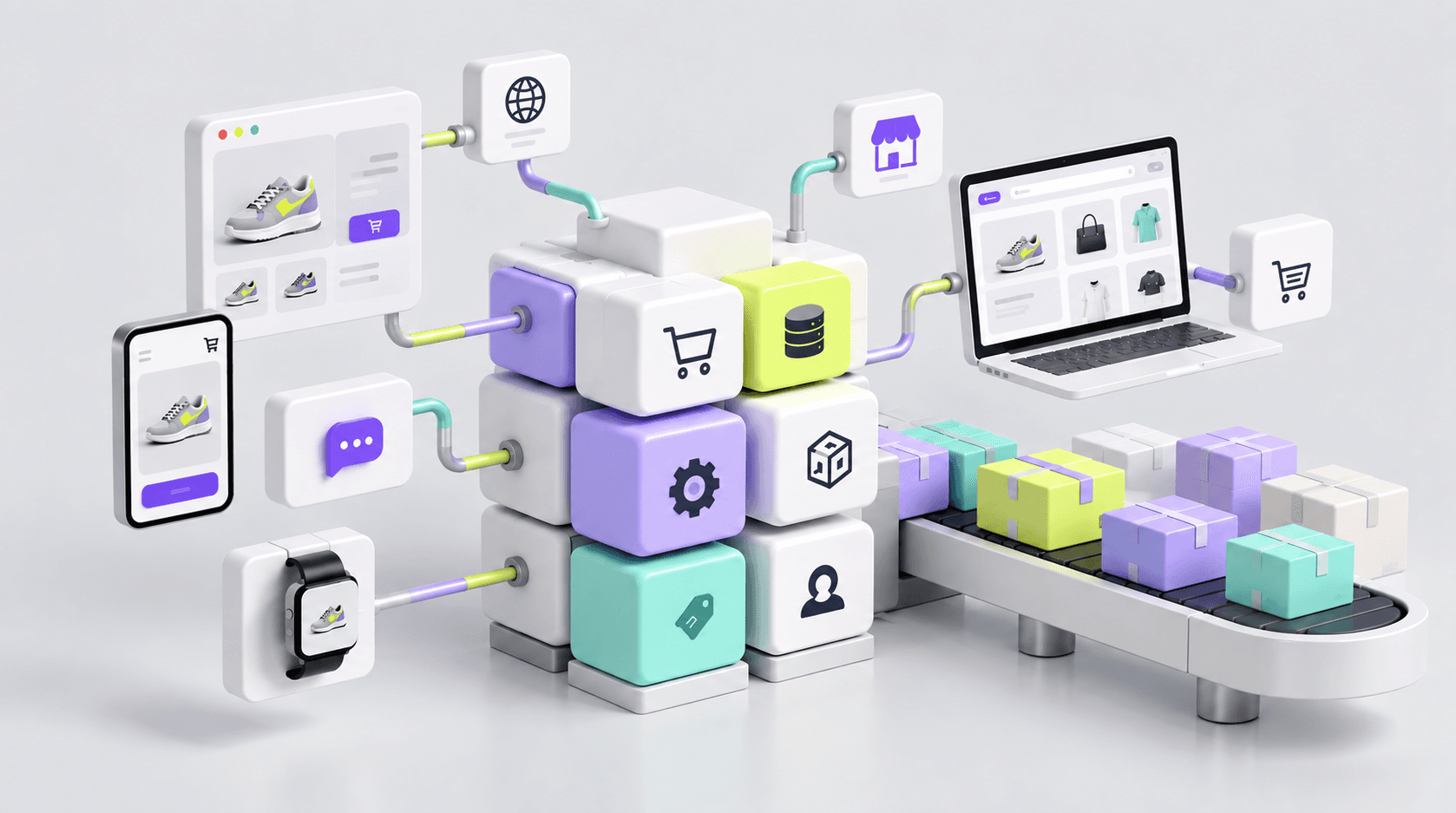
Composable commerce takes the same idea further. Content, search, product information and orders run as separate services, connected through APIs and hosted in the cloud, with the presentation layer kept apart (MACH Alliance, 2026). If your problem is the storefront, headless may be all you need. If several parts of the stack are holding you back, composable lets you swap them out one by one.
Start with the store you have
Before you pick an architecture, check whether the platform is really the problem. Average cart abandonment is 70.22% across 50 studies, and 63% of mobile sites have mediocre or worse checkout usability (Baymard Institute, 2025). A lot of that comes down to things you can fix now, like delivery costs that show up too late, no guest checkout, weak product filters or a clunky payment step. Most of those are settings or supported extensions. If you've made the fixes and still hit platform limits, that's when migration makes sense.
| Current situation | First option to evaluate |
|---|---|
Standard catalogue and a small technical team | Improve the existing storefront and checkout |
Distinctive experience with reliable core commerce operations | Add a headless frontend while retaining the backend |
Several channels and recurring integration constraints | Assess composable services capability by capability |
Inconsistent data or unclear performance measures | Improve data and measurement before migration |
Where headless makes sense
Headless earns its place when the experience you want is more than your current storefront can handle. Think of a retailer selling through a website, a mobile app and screens in its stores. With one commerce engine feeding all three through APIs, a price change happens once and stock stays in sync. Content-heavy brands are the other obvious case, such as a homeware store whose room guides double as product pages.
On Shopify, that's Hydrogen. It's a framework for custom storefronts with server-side rendering, with Oxygen to host them, while Shopify keeps handling orders (Shopify Developer Documentation, 2026). Many builds also keep the platform's checkout, leaving payments and compliance with the provider.
What you take on
More control comes with more work. Headless commonly requires dedicated engineering resources and extra frontend maintenance (Shopify, 2026). Someone, in-house or at your agency, has to own hosting, monitoring, analytics and integration testing, so budget for year two as well as the build.
Security is part of that. One of the most serious API risks is broken object-level authorization, where a service doesn't check whether someone is allowed to see a particular record (OWASP, 2023). In a store, that could be an order lookup that shows any order to anyone who types in the right number. The check is simple to build before launch. Dealing with an exposed customer record afterwards is not.
Speed and SEO
Headless can make a store faster, but not by default. Heavy JavaScript and too many API calls can leave you slower than before, so measure your current site first. Core Web Vitals give you the targets: main content loaded within 2.5 seconds, a response to a tap within 200 milliseconds and layout shift of 0.1 or less, measured at the 75th percentile of visits (Google, 2025). Track them on real mobile traffic alongside conversion.
SEO is easy to break during a migration. Server-side rendering or pre-rendering helps users and crawlers reach your content, and every old URL should redirect to its matching new page (Google Search Central, 2026). Keep product URLs and check metadata. Organic traffic takes years to build and days to lose.
Building the business case
A good migration case ties a platform limit to a cost you're already paying. Maybe every campaign waits weeks for developers, or the same catalogue update has to be made by hand in three regional stores. Put a number on it. Then compare the one-time cost of migrating with what you'd gain over a realistic period, net of ongoing platform, hosting and support costs. Until a pilot proves it, treat any conversion uplift as an assumption.
Migrating in stages
You don't have to replace everything at once. The strangler fig approach swaps parts out gradually until the old system can be switched off (Fowler, 2024).
- Choose one measurable problem. Note today's performance, what better looks like and who measures it.
- Map the dependencies. Decide which service owns product data, prices, inventory and orders.
- Run a small pilot. A single regional storefront or editorial journey is plenty.
- Plan the data move. Do a test migration of accounts, orders and subscriptions first.
- Review before going further. Look at results, incidents and cost, and have a rollback plan ready.
Getting your catalogue ready for AI
Most AI search tools and shopping assistants work by retrieval. When a customer asks something, they pull the relevant product records and answer from those, so your catalogue data matters more than the model.
Clean data means better recommendations and fewer basic questions for your support team. For orders or accounts, the assistant should only see records that belong to the signed-in customer.
Where to start
Headless is worth it when a custom storefront solves something your setup can't. Composable is worth it when separate services make frequent changes easier to ship. Not sure which? Spend two weeks on one important customer journey, then compare three options: improve the current store, add a headless front end, or replace one backend system. Start small. Good migrations have a clear problem and a way to prove it's fixed.
FAQ
Will our existing apps work with a headless storefront?
Some will. Apps that only add features to your theme usually won't, because there's no theme anymore. Apps with an API, like most review and loyalty tools, can be reconnected, but someone has to build that.
How long does a migration take?
It depends on scope more than technology. A pilot on one storefront is a small project. Moving the full catalogue, customer accounts and every integration is a big one, so map dependencies before you estimate.
Can marketing run a headless store without developers?
Day to day, yes, as long as the CMS has visual editing, preview and scheduling. Ask to see those workflows before you sign. New page templates and integrations will still need a developer.
Is headless only for large companies?
No, but you need people to maintain it. Without that, a good theme and a few extensions go further.
How do we avoid getting locked in to a vendor?
Before signing, check that you can export your product, customer and order data, that the APIs are well documented, and what the contract says about leaving. Switching a service later is still real integration work.
Sources
- MACH Alliance. MACH Manifesto. Accessed 12 October 2026.
- Shopify Developer Documentation. Hydrogen and Oxygen fundamentals. Accessed 12 October 2026.
- Shopify. Headless Commerce: Benefits, Trade-offs, and When To Use. 2 June 2026.
- Baymard Institute. 50 Cart Abandonment Rate Statistics 2026. Updated 22 September 2025.
- Baymard Institute. Checkout UX 2025: 10 Pitfalls and Best Practices. Updated 25 November 2025.
- Google, web.dev. How the Core Web Vitals metrics thresholds were defined. Updated 7 May 2025.
- Google Search Central. Understand JavaScript SEO Basics. Accessed 12 October 2026.
- Google Search Central. Site Moves and Migrations. Accessed 12 October 2026.
- OWASP. API1:2023 Broken Object Level Authorization. 2023.
- Martin Fowler. Strangler Fig. 22 August 2024.
Tags
Services used
Author

Software Developer
Reeyaz loves working across backend engineering and infrastructure, building software that performs, scales and thrives in production.