
The Intelligent Digital Stack: Building Scalable Products with Next.js, NestJS, Sanity, and AI
TL;DR
The Intelligent Digital Stack combines Next.js, NestJS, Sanity, and AI to build scalable, high-performance digital products where content, logic, and intelligence are seamlessly integrated from day one.

The way digital products are built is undergoing a structural shift.
According to McKinsey (2024), companies that effectively integrate AI into their digital products can increase productivity by up to 40%, while Gartner projects that by 2026, over 80% of customer interactions will involve AI in some form. At the same time, performance expectations continue to rise—Google research consistently shows that even 100ms latency improvements impact conversion rates.
This creates a new baseline: modern products must be fast, flexible, and intelligent by design.
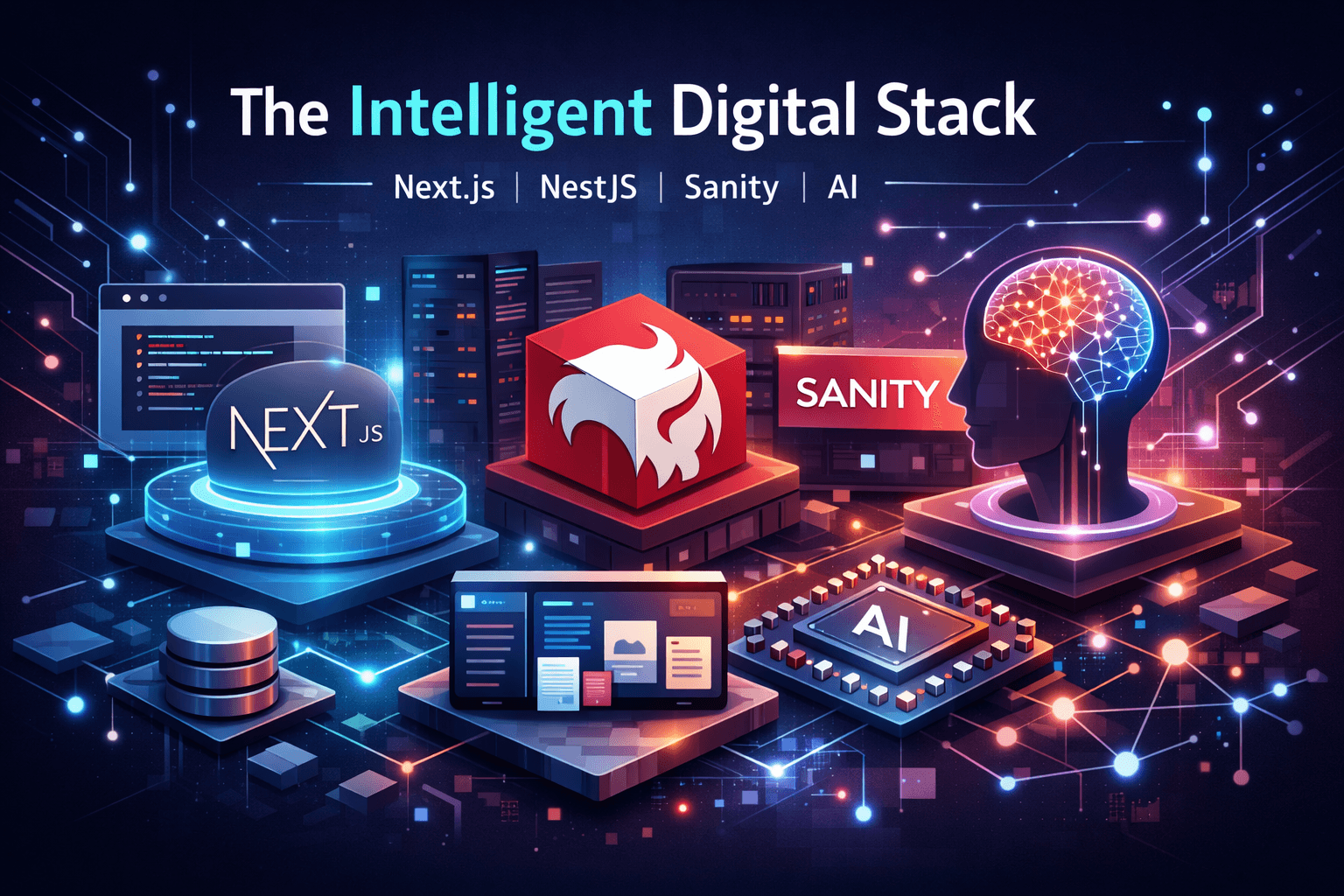
At Hypnotic, we approach this with what we call the Intelligent Digital Stack—a system that combines:
- Next.js → frontend performance and delivery
- NestJS → structured backend logic
- Sanity → flexible content architecture
- AI services → embedded intelligence layer
This is not just a tech stack. It’s a way to design systems where AI is not an add-on, but a native capability.
1. Next.js: The Foundation of High-Performance Interfaces
Next.js has become the default choice for serious frontend architecture—not because it’s trendy, but because it solves real constraints at scale.
What makes it critical
- Hybrid rendering model (SSR, SSG, ISR, RSC)
You choose the optimal rendering strategy per route or component. - Edge execution
Logic runs geographically closer to users, reducing latency globally. - Tight integration between frontend and backend concerns
Eliminates unnecessary API layers in simpler use cases.
How we use it in production
- Static generation for SEO-critical pages
- Server Components for authenticated areas
- ISR for content-driven sections powered by CMS
This allows us to balance performance, scalability, and maintainability without fragmenting the codebase.
2. NestJS: Bringing Structure to Backend Complexity
As systems grow, unstructured backend logic becomes a liability.
NestJS provides a strong architectural foundation for scaling applications:
- Dependency injection by default
- Modular architecture
- Support for REST, GraphQL, WebSockets
- First-class integration with queues and background jobs
Where it becomes essential
- Complex business logic (pricing, permissions, workflows)
- Multi-tenant SaaS platforms
- External integrations (payments, CRMs, third-party APIs)
- Asynchronous processing (queues, events)
Why not rely only on Next.js APIs?
Because beyond a certain complexity threshold, you need:
- Clear domain boundaries
- Testable services
- Scalable infrastructure patterns
NestJS enforces this discipline early.
3. Sanity: A CMS That Adapts to the Product (Not the Other Way Around)
One of the most underestimated bottlenecks in digital products is the CMS.
Most traditional systems impose rigid structures:
- Fixed templates
- Limited customization
- Poor developer experience
Sanity takes a fundamentally different approach.
Why we chose Sanity?
- Schema-as-code → full control over content models
- Customizable backoffice (Studio)
- Real-time collaboration
- API-first (GROQ queries)
The key advantage: Custom backoffice for clients
Instead of delivering a generic CMS, we build tailored editorial experiences:
- Custom input components
- Structured content workflows
- Role-based interfaces
- Modular content blocks (page builders without the mess)
This is critical because:
The CMS is not just a tool—it’s part of the product experience for internal teams.
Example schema:
export default {
  name: 'page',
  type: 'document',
  fields: [
    { name: 'title', type: 'string' },
    { name: 'modules', type: 'array', of: [{ type: 'hero' }, { type: 'contentBlock' }] }
  ]
}
This enables fully composable pages, without sacrificing structure or performance.
4. AI as a Native Layer (Not an Add-on)
AI is often treated as a feature. That approach is already outdated.
The shift happening now is architectural:
AI is becoming part of the system’s core capabilities.

Where AI integrates in the Intelligent Digital Stack?
- Content systems
- Auto-generation of drafts
- SEO optimization
- Content summarization and localization
- User experience
- Conversational interfaces
- Smart recommendations
- Semantic search across content and data
- Internal operations
- Automated tagging and classification
- Data enrichment pipelines
- Workflow automation
Practical example: AI-powered content pipeline
A real-world implementation we deploy:
- Content team creates a draft in Sanity
- AI enriches it automatically:
- Generates SEO metadata
- Suggests internal linking
- Produces summaries and variants
- NestJS handles orchestration and validation
- Next.js renders optimized content with ISR
Result:
- Faster publishing cycles
- Higher content quality
- Reduced manual workload
LLM Optimization: Preparing Products for AI Consumption
As AI systems become primary consumers of web content (not just users), a new layer of optimization is emerging: LLM discoverability and readability.
We treat this as part of the product architecture—not an afterthought.
What we implement
1. llms.txt
A machine-readable entry point that helps LLM agents understand:
- What the product does
- Key entities and concepts
- Available content domains
- Structured summaries of core pages
2. llms-links.txt
A curated list of high-signal URLs:
- Canonical pages
- API endpoints (when relevant)
- Structured content hubs
This acts as a guided crawl map for AI agents, similar in spirit to sitemap.xml, but optimized for semantic understanding rather than indexing.
Why this matters
Traditional SEO is built for search engines.
This layer is built for AI systems that interpret, summarize, and recommend content.
That changes the optimization model:
- From keywords → meaning and structure
- From ranking → retrievability and clarity
- From pages → knowledge graphs
Practical impact
By structuring content for LLMs:
- Products become more visible in AI-driven interfaces
- Content is more accurately interpreted and summarized
- Brand positioning is preserved when surfaced by AI systems
Strategic perspective
This is the early stage of a shift:
Websites are no longer just rendered for humans—they are also parsed, embedded, and reasoned over by AI.
Designing for that reality now creates a compounding advantage as AI-native discovery grows.
Why AI is no longer optional
- Users expect instant, personalized experiences
- Content velocity is increasing exponentially
- Competitive advantage is shifting toward automation + intelligence
Products without AI will not “fail”—they will simply become less relevant over time.
5. Reference Architecture
A typical deployment of the Intelligent Digital Stack:
[ Client (Web/App) ]
          ↓
     Next.js (Frontend + Edge)
          ↓
     NestJS (API Layer)
          ↓
  ┌───────────────┬───────────────┬───────────────┐
  │               │               │               │
Sanity CMS     Postgres (Neon)   AI Services     Redis / Queues
(Content)      (Transactional)   (LLMs/APIs)     (Async jobs)
6. Key Architectural Principles
Decoupling
Each layer evolves independently.
Performance-first
Static generation wherever possible.
Composability
Reusable components across frontend, backend, and CMS.
Intelligence by default
AI is integrated from day one—not retrofitted.
7. Common Pitfalls (and How We Avoid Them)

1. Overusing SSR
Use static generation and caching aggressively to reduce load and latency.
2. Mixing business logic into Next.js
Keep complex logic in NestJS to maintain scalability and clarity.
3. Treating the CMS as a database
A CMS is designed for content, not transactions.
We separate concerns clearly:
- Sanity → structured content
- PostgreSQL (via Neon) → transactional data
This includes:
- Users
- Orders
- Payments
- System state
This separation ensures:
- Data integrity
- Better performance
- Clear system boundaries
4. Superficial AI integration
Adding a chatbot is not “AI strategy.”
We focus on:
- Real workflow improvements
- Measurable efficiency gains
- Deep integration with product logic
8. Why the Intelligent Digital Stack Works
This approach aligns with how modern products evolve:
| Layer | Role | Technology |
|---|---|---|
Interface | Fast, scalable frontend | Next.js |
Logic | Structured backend | NestJS |
Content | Flexible, composable CMS | Sanity |
Data | Reliable transactional storage | Postgres (Neon) |
Intelligence | Automation & personalization | AI services |
The question is no longer “which framework should we use.”
The real challenge is:
How do we build systems that are fast, flexible, and intelligent from the start?
The Intelligent Digital Stack is our answer.
It enables us to deliver digital products that:
- Scale without restrictions
- Adapt to changing business needs
- Continuously improve through embedded intelligence
This is the new standard for modern digital products.
Sources:
1. McKinsey – AI productivity impact
2. Gartner – AI in customer interactions (forecast)
(Gartner forecasts vary slightly by report, but consistently indicate >80% AI adoption in customer interactions/support contexts.)
3. Google – Impact of latency on performance
- https://web.dev/performance/
- https://research.google/pubs/pub38355/ (Google study on speed and user behavior)
These sources are widely cited in product and performance engineering discussions and align with current industry benchmarks.
Tags
Services used
Author

Founder & CTO at Hypnotic
15+ years of experience across multiple categories and disciplines in the digital world. With a strong expertise in web and mobile development, team and project management, marketing development and execution, business development and agency operations in general. Vast and deep knowledge on various programming languages and frameworks, both old-school and modern, both backend and frontend (full stack development), employing a great passion and creativity in every project.