
The Post-Syntax Era: Mobile Development in 2026 and beyond
TL;DR
How is mobile development today? How will it be in the future? In this article, we'll be exploring the status of current mobile stack development, how it is evolving, and how AI is supporting it.

It feels like a lifetime ago that we were discussing whether cross-platform could ever truly match native performance. I remember the early days of Flutter—the excitement of the first stable release, the struggle of writing plugins for every basic feature, and how hard it was sometimes to convince customers (and sometimes CTOs) that Flutter was a legitimate contender.
Fast forward to 2026, and the landscape is unrecognizable. As someone who has spent the last 8 years deploying mid- to large-scale apps, mainly with Flutter, I’ve seen our role shift from "syntax experts" to "architectural orchestrators."
If you're wondering where the mobile stack is headed, grab a coffee. Let’s look at the current state of play and why the "vibe" of development is shifting.
The 2026 Tech Stack: Efficiency at Scale
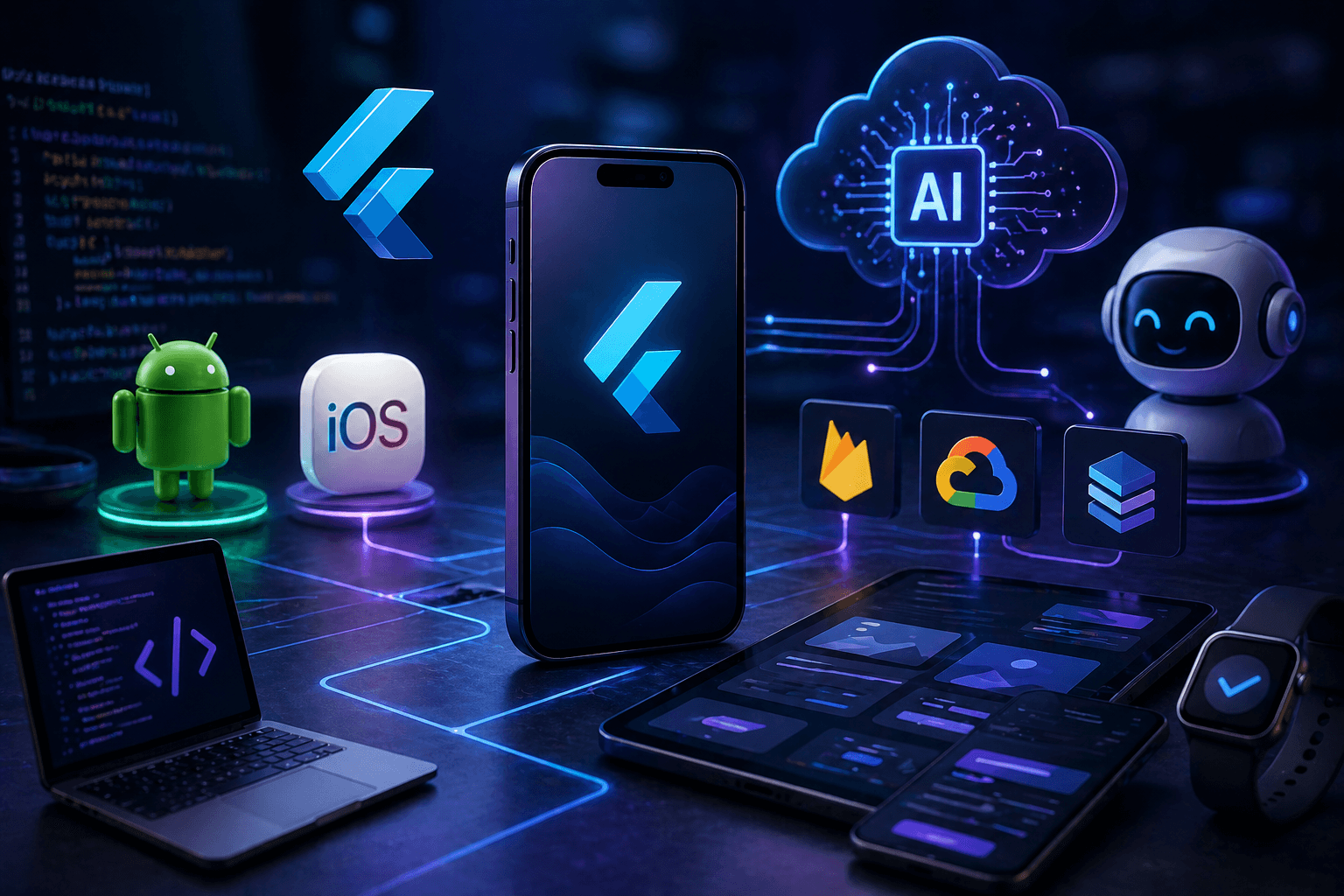
In 2026, we are no longer fighting the framework. The "Jank-pocalypse" is a thing of the past. For those of us in the Flutter ecosystem, the maturity of Impeller (Flutter's rendering engine) has effectively neutralized the "native vs. cross-platform" debate for 99% of use cases. It has been an amazing journey, and apps are stunning these days.
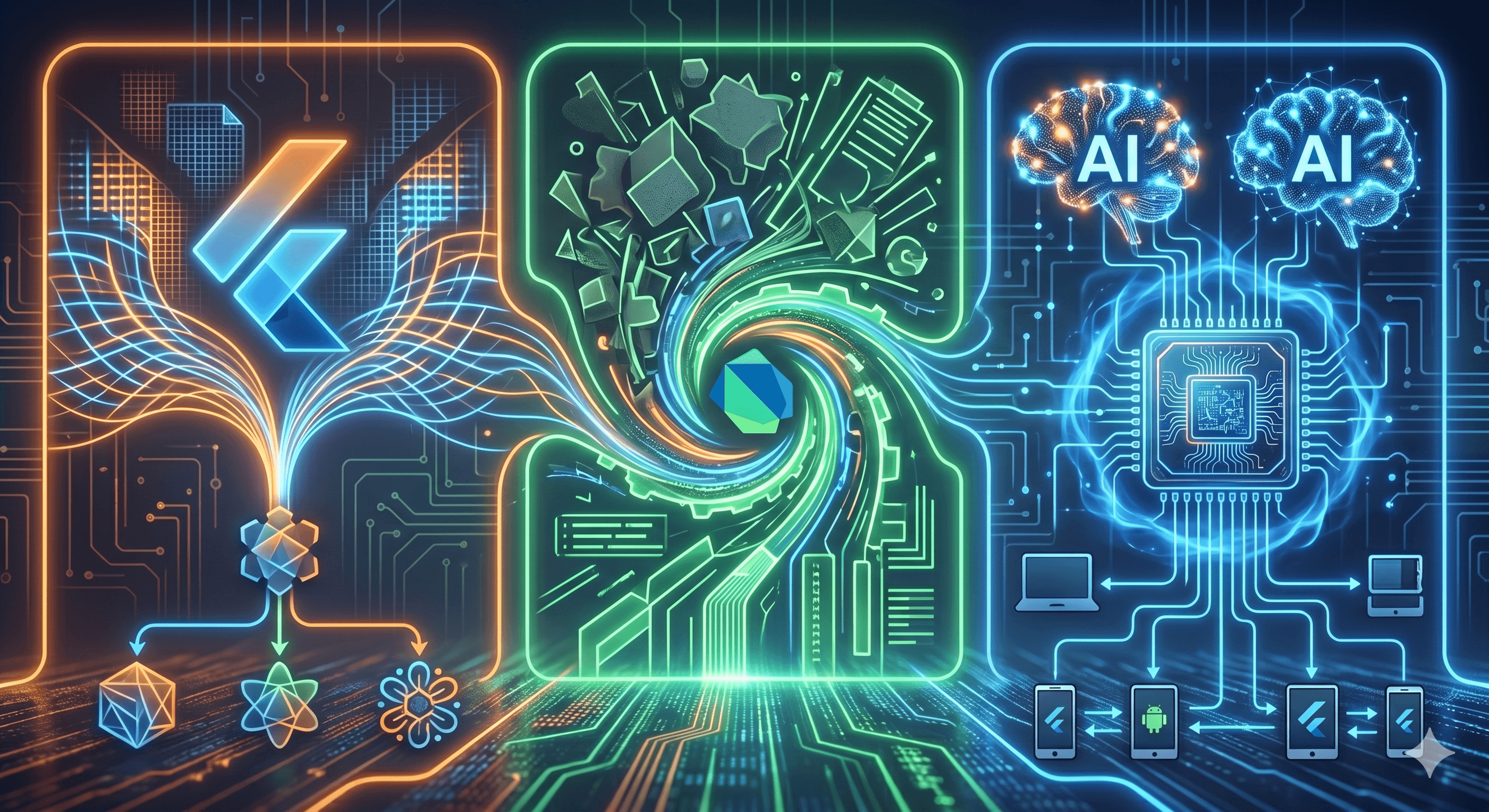
Current Tech Pillars:
- Wasm (WebAssembly): Flutter Web is no longer a "side project." With Wasm reaching full maturity, we’re deploying web apps that run at near-native speeds, allowing for true codebase unification across iOS, Android, and the browser.
- Dart Macros: Static metaprogramming has finally killed the boilerplate. We no longer spend hours writing JSON serialization logic or manual dependency injection. The compiler handles it, making our codebases leaner and more readable.
- On-Device LLMs: We aren't just calling APIs anymore. We are deploying quantized models (such as Gemini Nano) directly into the app bundle to enable privacy-first, offline-capable AI features. Devices are going along so we just take advantage.
The AI Revolution: From Copilots to Agents
AI hasn't replaced us, but it has fundamentally changed our "editor-in-chief" duties. In 2026, we’ve moved past simple code completion. We now use Agentic Workflows.
Instead of writing a login screen, I describe the user flow to an AI agent that has access to our design system and internal API documentation: It generates the UI, wires up the state management (usually a highly optimized version of MobX, Riverpod or Bloc), and writes the integration tests — this is the perfect agent scenario when things are properly integrated, but we all know that sometimes this isn’t what happen, more on that later.
How Flutter handles this: Flutter’s declarative nature is a perfect match for AI. Because the UI is code (widgets), AI agents find it much easier to "reason" about the layout than in XML- or storyboard-based systems. Flutter has leaned into this by optimizing its tooling for LLM-assisted refactoring. This is great, seeing frameworks following the trend.
The Rise of "Vibe Coding"
A new term has entered the dev-lexicon: Vibe Coding. This refers to the practice of using high-level natural language prompts to describe the intent and feel of an app, letting AI handle the heavy lifting of implementation. This has its pros and cons, and we, as developers or architects, need to really be careful on how to balance them.
Feature | Pros | Cons |
|---|---|---|
Speed | Can go from mockup to MVP in hours. | Harder to debug "black box" logic. |
Accessibility | Lowers the barrier for non-technical founders. | Technical debt can accumulate if not "curated" by an expert. |
Creativity | Allows for rapid experimentation with animations and layouts. | Risk of "generic" app feels if the "vibe" isn't specific enough. |
As an experienced dev, I see vibe coding as a superpower for prototyping, but like mentioned before, it can be a nightmare for maintenance and/or get the work done if you don't have a senior engineer overseeing the underlying architecture or tools aren’t properly integrated. There are also a couple of technical challenges that you can’t solve with AI: you can "vibe" your way into a UI, but you can't "vibe" your way through a complex race condition in a multi-threaded database sync.
How Companies are Adapting
The days of 20-person mobile teams are getting shorter over the time, unless you work on a tech giants. Companies are moving toward Hyper-Lean Teams. An IT company today expects (more than before) a single mobile developer to handle the entire lifecycle, aided by a suite of AI tools.
Deployment has expanded. We are now mostly deploying to:
- Mobile & Web: The standard duo.
- Spatial Computing: VisionOS and Android-based XR headsets are now standard targets for enterprise apps.
- Desktop: Flutter has become the go-to for internal corporate tooling on Windows and macOS due to its incredible development speed.
The New Job Market: Beyond the Coder
The roles are shifting. We are seeing the rise of:
- AI Orchestrators / Prompt Engineers: Developers who specialize in crafting the "constraints" for AI to build within. They don't just ask for a "button"; they define the architectural boundaries that ensure the AI-generated code is scalable. A good prompt can save you a lot of time (and cost!);
- Plugin Archaeologists: Since most "common" code is generated, the high-value work is now in writing high-performance, native C++ or Swift/Kotlin code for specialized hardware—the "glue" that AI still struggles to get perfect.
- Vibe Architects: Designers who have enough technical knowledge to guide the AI's creative output into something functional and performant.
Final Thoughts
In 2026, being a "Flutter Developer" means being, more than ever, a product creator. We use the most efficient tools available—whether that’s a macro, an AI agent, or a "vibe snippet"—to solve human problems. The stack is faster, the tools are smarter, but the core mission remains the same: building something people actually want to use. AI has been greatly helping us in providing much solid solutions but don’t replace our intelectual creativity which is the main orchestrator for a good AI aid.
We are the intelectual power than fuels AI. It doesn’t replace us, it enhances us so we can leverage our productivity and deliver much solid products — now with less excuses for error. 🤓
Tags
Author

Mobile Engineer
Lead Software & Architecture Engineer specializing in mobile architectures, with 6+ years of experience in Flutter since its alpha. Skilled in Java, Objective-C, C#, Dart, C++, and C, I’ve led high-scale projects, contributed to open-source, and actively participate in Stack Overflow. Former Flutter Portugal organizer, speaker, and workshop leader, I’m passionate about continuous learning, mobile development, and sharing knowledge.