
AEO vs. GEO: What They Mean and Why Your Site Needs Both in 2026
TL;DR
Two new acronyms for being found by AI, explained without the jargon

Type a question into ChatGPT, Perplexity, or Google's AI Overview and you may get a complete answer generated by retrieving and synthesising information from several web sources, without ever visiting one of them. That shift has quietly rewritten the rules of digital visibility. Ahrefs's most recent analysis found that the presence of an AI Overview is now associated with a 58% lower average click-through rate for the top-ranking organic result, relative to what that result would likely have earned without one.1 Gartner predicted a version of this in 2024, forecasting that traditional search volume would fall 25% by 2026 as AI chatbots absorbed queries that used to run through a search box.2
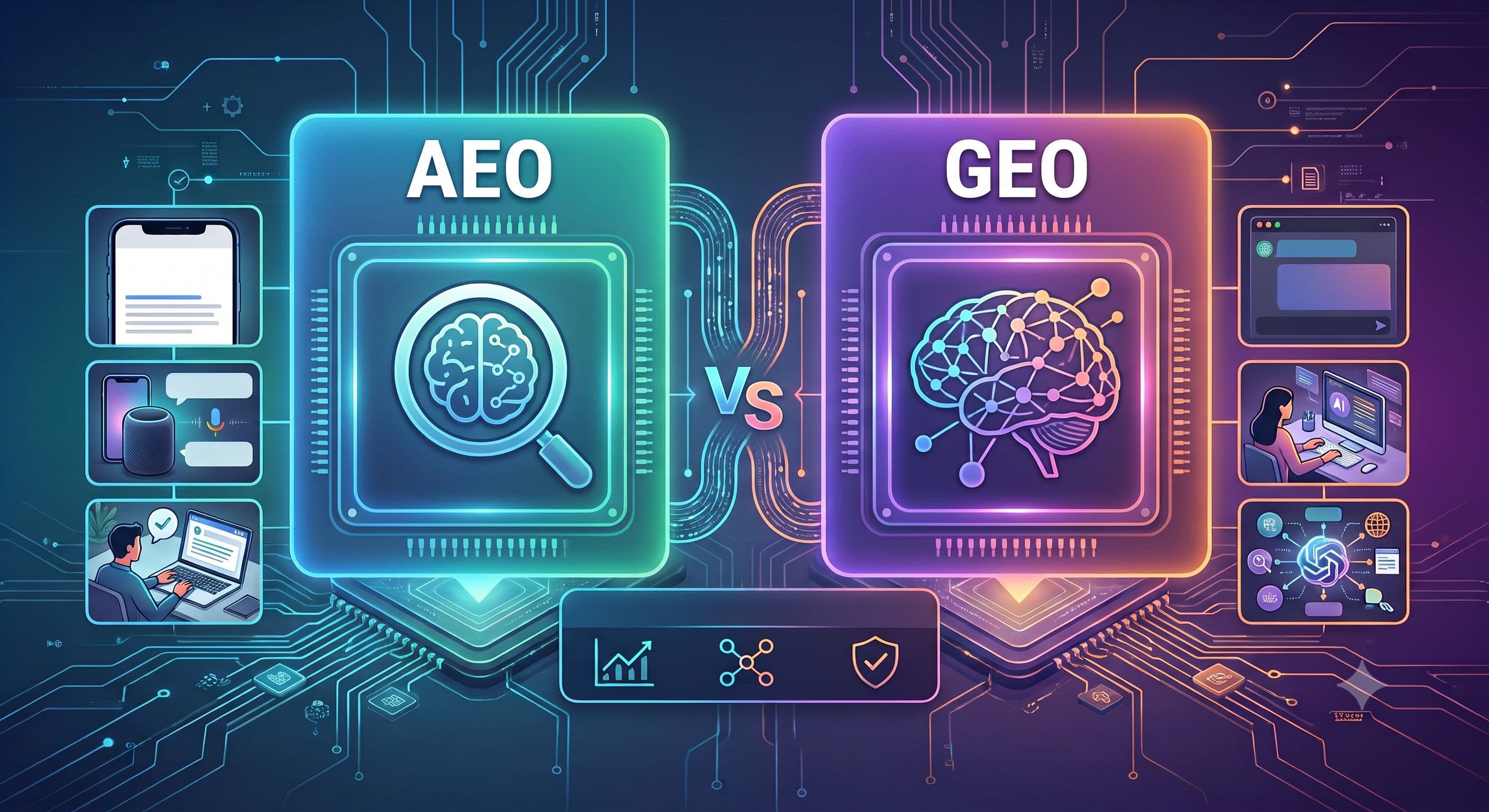
Two disciplines have grown out of this shift: AEO and GEO. They overlap, but optimising for one does not automatically make you visible in the other. This article explains what each means, where they differ, and what to change on your site now.
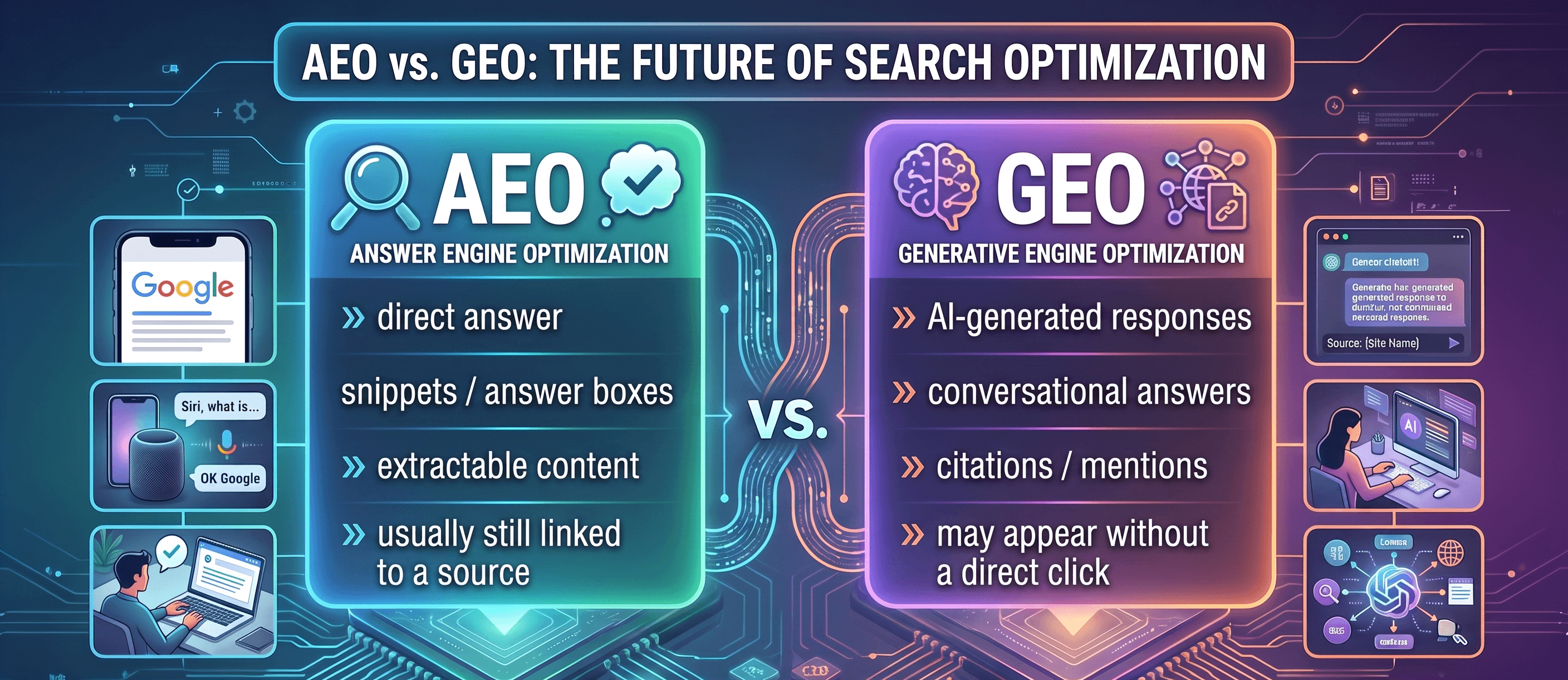
We use AEO for direct, extractable answers that usually link to a source, and GEO for visibility inside fully generated conversational responses, where there may be no link. The boundary is a spectrum rather than a wall, but the distinction remains useful.
THE ANSWER LAYER
What AEO Actually Means
Answer Engine Optimization, or AEO, is the practice of formatting content so a machine can lift a direct answer out of it and present that answer as the response, not just a link to your page. Think of it as writing for extraction. Featured snippets started this shift years ago; Google's AI Overviews, Bing's Copilot answers, and voice assistants like Siri or Alexa now extend it further, prioritising content that can be interpreted and surfaced as a direct response, though generative systems may synthesise several sources rather than extract one block verbatim.
The scale and the stakes have changed. Missing a featured snippet used to cost a business only a little visibility. Now that AI Overviews appear across a large share of searches, missing the answer slot can mean losing the visit before it happens. Ahrefs's data shows exactly that: among keywords that went on to trigger an AI Overview, average CTR for the first-position organic result fell from 7.3% in December 2023 to 1.6% in December 2025. After accounting for the broader decline in informational-search CTR, Ahrefs estimated that the presence of an AI Overview reduced the expected click-through rate by approximately 58%.1
A recipe or how-to page is the clearest case. Place a concise, self-contained answer near the top, for example 40 to 60 words, before moving into greater depth. This is a content guideline, not a platform requirement, but it gives a machine something clean to lift while the rest of the page provides context.
For a business, AEO is a brand-recall and trust play more than a traffic play. Even when the click does not happen, showing up as the answer puts a name in front of the person asking. Skip it, and a competitor's name gets that impression instead, on a query a site may have ranked first for.
THE CITATION LAYER
What GEO Actually Means
Generative Engine Optimization, or GEO, is the practice of improving how visible, influential, and attributable a source becomes inside a fully generated answer, the kind returned by ChatGPT, Claude, Perplexity, or Gemini when there is no results page at all, just a written response. That can mean being named directly, being quoted, or simply having your information folded into the answer's own sentences without any citation attached. For a business, the version that matters most is usually the first two: having a brand, product, research, or point of view surfaced or cited when someone asks a related question.
This is a newer, more academic discipline than AEO. Researchers from Princeton, Georgia Tech, the Allen Institute for AI, and IIT Delhi published the paper that coined the term as a 2023 preprint, later presented at KDD 2024, testing which content changes improved how prominently a source appeared within a generative response. The strongest results came from citing sources, adding direct quotations, and adding statistics, producing relative improvements of 30% to 40% on the study's Position-Adjusted Word Count metric and 15% to 30% on its Subjective Impression metric, varying by query type and domain. Fluency and readability helped too. A more persuasive, authoritative tone did not produce a significant improvement overall, and keyword stuffing offered little to no benefit, occasionally hurting results.3
Picture someone asking ChatGPT what the best project management tool is for a five-person agency. No results page, no rankings, just a paragraph naming two or three tools and explaining why. A product named there has entered the buyer's shortlist before a single tab is opened. A product left out was never in the conversation, no matter how well it would have ranked on Google for the same question.
This is a pipeline problem, not a traffic problem. Decisions are shaped before the click, sometimes before any click happens. Teams measuring success only through sessions and rankings miss a growing part of how buyers build shortlists.
ONE ACRONYM SOUP, TWO JOBS
Why Companies Keep Treating Them as the Same Thing
The confusion is understandable. AEO and GEO both react to the same root cause, AI systems inserting themselves between a question and a website, and they share some of the same underlying inputs: clear structure, credible sourcing, unambiguous claims. AEO targets a specific answer surface that usually still includes a link back to the source. GEO targets a fully generated response with no results page and often no link at all. In practice, the two blend together more than a clean definition suggests. An AI Overview is itself a generative response sitting inside a results page, so treating AEO and GEO as entirely separate categories can be as misleading as treating them as the same thing.
Gartner's own framing captures why this matters at the strategy level, not just the tactical one. Vice President Analyst Alan Antin has described generative AI tools as “becoming substitute answer engines”2 for queries that used to run through a search box. A substitute answer engine does not just rank a page differently; it can replace the entire interaction a business used to have with a searcher.
The mistake we see most often: a company invests heavily in schema markup and FAQ blocks, AEO's home turf, and assumes that work automatically makes it visible to ChatGPT or Perplexity too. It does not, not reliably. A generative engine decides whether a page is credible, specific, and well-attributed enough to fold into its own generated sentence, not whether it matches a snippet shape. Those are related skills. They are not the same skill.
The practical cost of conflating them is a visibility gap most teams do not know they have. A featured-snippet count can climb while a brand never gets mentioned in a single ChatGPT answer, and nothing in a standard rank-tracking dashboard will show that gap forming.
THE RECEIPTS
What Actually Changed Between 2024 and 2026
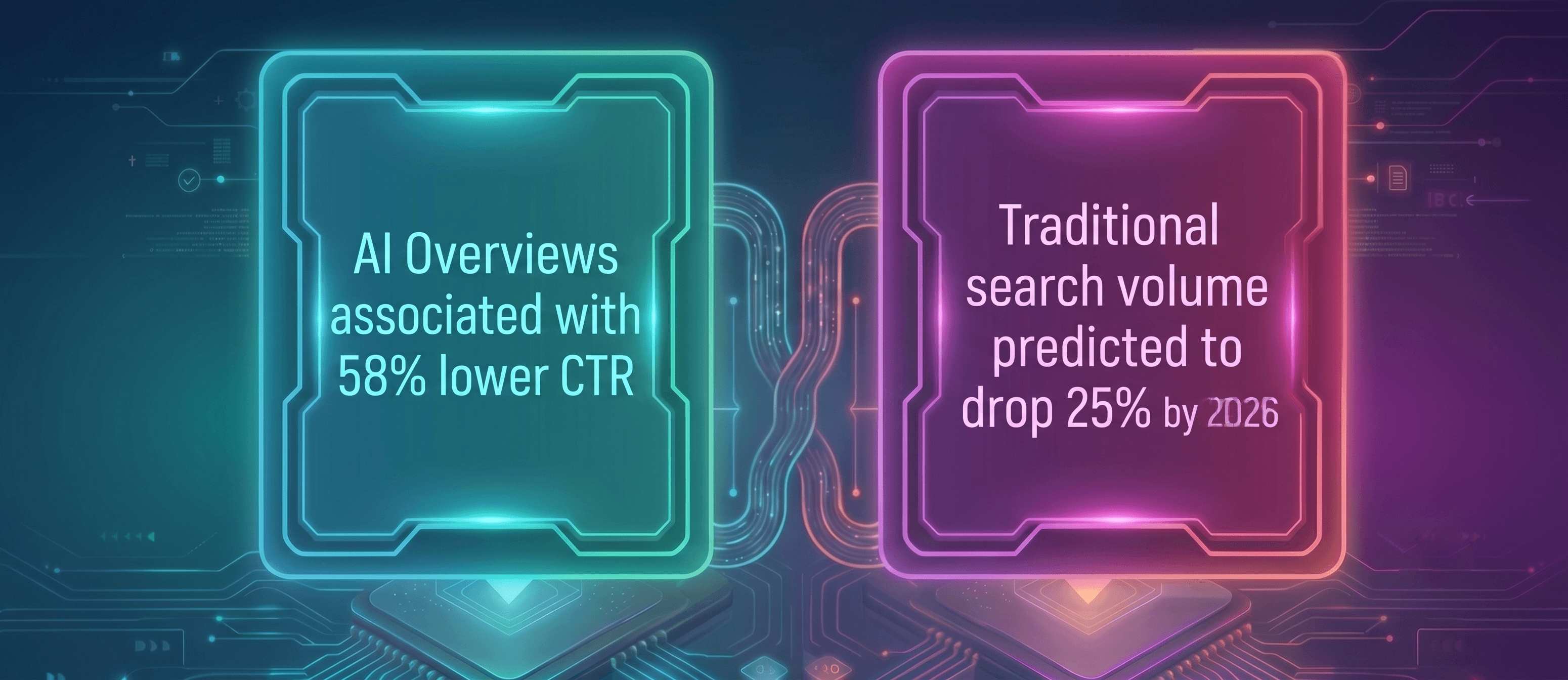
Gartner's 2024 prediction of a 25% drop in traditional search volume by 2026 was treated as aggressive.2 Two years later, the more useful signal is how sharply AI Overviews have changed click behaviour.
That shift shows up clearly in the numbers. Ahrefs's repeated study, run first in early 2025 and again in December 2025, found the click-through rate hit on the top organic result grew from a 34.5% reduction to a 58% reduction in a single year, as AI Overviews rolled out to more countries, more languages, and more query types.1 The trend line, not the single data point, is the warning: this was not a one-time correction, and the measured impact was still increasing at the time of the second study.
A publisher or e-commerce site tracking only Search Console rankings could see steady position-one rankings and conclude everything is fine. Meanwhile, actual visits to that page could have fallen by more than half over the same period, purely because the click got absorbed by an AI Overview sitting above it.
The revenue consequence is direct. Marketing budgets built around cost-per-click and session volume measure an increasingly smaller slice of a page's actual influence. A page can shape a decision, get a brand mentioned by name, and still show a Google Analytics report heading the wrong direction. Budget and reporting need a metric for that influence, not only for the click.
THE PLAN OF ACTION
Where the Investment Pays Off and Where to Start
In plain language: help the machine reading a page understand, without guesswork, what it is about, who wrote it, and why it should be trusted. Structured data, most often implemented as schema markup, a standardized code snippet labelling the author, organization, publish date, and content type, is one part of that foundation.
It is worth being precise here, because structured data gets oversold constantly. Google's own documentation states plainly that structured data is not required for its generative AI search features, and that there is no special schema.org markup for AI Overviews or AI Mode.4 It remains useful for rich-result eligibility, but not as a direct lever for AI citation.
The Princeton GEO research points at a more direct lever: the words on the page itself. Citing sources, adding statistics, and writing fluent, clear prose reduce the same ambiguity that structured data addresses at the code level, just inside the sentences a model actually reads.3
A B2B software company publishing a comparison guide gets value from both. Schema markup identifying the page as an Article, with a clear date and named author, can make it eligible for a rich result. The byline, dated statistics, and cited sources inside the copy can increase the likelihood of the company being surfaced or cited when someone asks for a recommendation. One investment supports classic SEO; the other supports GEO.
The efficient move is to stop treating AEO and GEO as separate content briefs. Clear authorship, explicit sourcing, and well-structured writing serve both; schema markup is worth doing for its own, more modest reasons, not because it is secretly the key to AI citation.
This Week, Not Eventually
Do not try to retrofit an entire site at once. That is how these initiatives stall. Pick the single page that drives the most organic traffic or sales conversations, and do four things to it this week: add a concise, self-contained answer near the top, as a content guideline rather than a technical requirement; add one specific, dated statistic with its source named inline; make sure the page has a visible author and publish date; and confirm in Search Console that Googlebot can reach and index it.5 Separately, check server logs or a bot-monitoring tool to confirm OAI-SearchBot and PerplexityBot are not blocked in robots.txt, since Search Console will not show you that.6,7 Treat GPTBot and Google-Extended as separate decisions. GPTBot governs whether OpenAI may use crawled content for training. Google-Extended governs Gemini training and grounding and does not affect inclusion or ranking in Google Search.
Then run the same five or six buyer-intent questions through ChatGPT, Perplexity, and Google's AI Overview regularly, and track, by name, whether the brand shows up and which sources get cited alongside it. If the Generative AI performance report is available in Search Console, use it alongside manual prompt testing to track impressions, visible pages, and AI-search visibility over time.8 Pair that with AI-referral traffic already visible in analytics, ChatGPT appends a utm_source=chatgpt.com parameter to its referral links,9 and with branded-search trends. No single number tells the whole story yet, but tracking nothing guarantees you will not see the shift coming.
Want to know how visible your website is in AI search?
We can assess your technical setup, content structure, and current visibility to identify the improvements that could make the biggest difference.
Sources
- Ahrefs (Ryan Law and Xibeijia Guan), “Update: AI Overviews Reduce Clicks by 58%”, 2026.
- Gartner, Inc., “Gartner Predicts Search Engine Volume Will Drop 25% by 2026, Due to AI Chatbots and Other Virtual Agents”, 2024.
- Aggarwal, Murahari, Rajpurohit, Kalyan, Narasimhan, and Deshpande (Princeton University, Georgia Tech, Allen Institute for AI, and IIT Delhi), “GEO: Generative Engine Optimization”, preprint 2023, KDD 2024.
- Google Search Central, “Google’s Guide to Optimizing for Generative AI Features on Google Search”, 2026.
- Google Search Central, “AI Features and Your Website”, 2026.
- OpenAI, “Overview of OpenAI Crawlers”, 2026.
- Perplexity, “Perplexity Crawlers”, 2026.
- Google Search Central, “Introducing Search Generative AI Performance Reports in Search Console”, 2026. Rollout is incremental and may not yet be available on every account.
- OpenAI, “Publishers and Developers, FAQ”, 2026.
Tags
Services used
Author

Marketing Manager
Rita is Marketing Manager at Hypnotic. Her academic path began in architecture and later moved into graphic design, but her interests gradually shifted toward communication, strategy, and business. With experience in sales and project support, she eventually found her place in marketing. Curious by nature, she enjoys travelling and has recently made running and cycling an important part of her life.