

Website vs Platform
TL;DR
A website proves you exist. A platform is built to grow. Here is why the cheapest launch often becomes the most expensive rebuild.


The Line Between a Website and a Platform, and Why It Matters for Growth
In 2025, Search Engine Journal analyzed 892 domain migrations and found that the average site took 523 days to recover its pre-migration organic traffic, with 17% never fully recovering even after 1,000 days. That is not a story about bad developers. It is a story about companies that built a website to answer one question, “do we exist online,” and later needed it to answer a much harder one, “can this grow with us,” discovering too late that the two answers require different foundations. Most marketing and IT decision makers still choose a web project the way they choose a brochure: lowest quote, fastest delivery, done. Something online is almost always better than nothing, but a website built with no plan for what comes after launch quietly becomes the most expensive line in the budget, paid for later in lost traffic and structural rebuilds that a little upfront thinking would have avoided. The distinction that actually matters for growth is not “good site versus bad site.” It is website versus platform.
A Website Proves You Exist. A Platform Proves You Can Grow
A website, in the way most companies still buy one, is a set of pages that describe the business: who it is, what it sells, how to get in touch. It does its job the moment it looks correct on a screen. A platform starts from a different question: what does this system need to do for the business over the next two, three, or five years, not just on launch day. In practice, that means separating content from presentation, exposing an API layer other tools can connect to, and treating every page as a step toward a defined outcome, a lead, a sale, a login, rather than a static description. This is usually where “headless” or “composable” architecture comes up: content lives in one system, design in another, and the two communicate through APIs instead of being welded together, so either side can change without breaking the other.
The business implication is direct. A website is a cost center that needs refreshing every few years. A platform is infrastructure that compounds in value, because every campaign and integration builds on the same foundation instead of fighting it. Two proposals that look similar on price are often a brochure and a growth engine in disguise, and the difference rarely shows up in the first demo. It shows up eighteen months later, when one team is running structured experiments and the other is asking a developer to hand-edit a template just to change a headline.
The Cheapest Option Rarely Stays Cheap
Choosing the lowest bid, a generic template with no information architecture and no schema plan, is one of the most common and expensive mistakes in digital budgets, and it rarely looks like one at the time. The site launches, the savings are real, and the cost only shows up later, when the business needs a new section or a full platform change, and every one of those changes now requires redirect mapping and a period where search engines have to relearn the site from scratch.
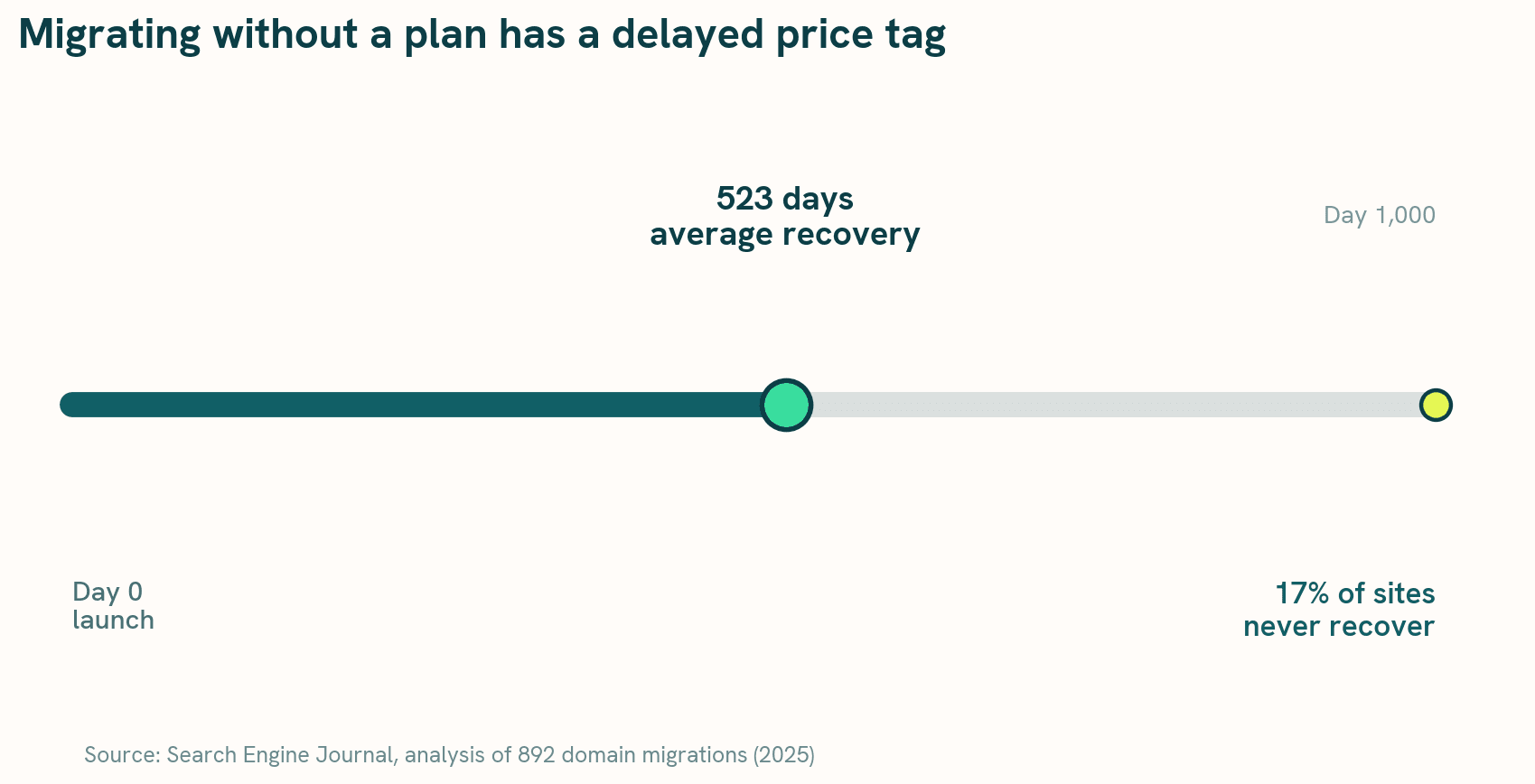
Most of the migrations behind that 523-day average were not failed projects. They were reasonable businesses that had outgrown a foundation never built to be outgrown gracefully. None of this makes WordPress or low-code inherently wrong; plenty of well-planned sites run on exactly those tools. It means the real cost of a platform decision is not the invoice for building it, it is the invoice for changing it, and that second invoice stays invisible until the business tries to grow. Before signing off on any web project, ask what the site needs to do in eighteen months, and choose a foundation, whatever the price point, that can absorb that change without a rebuild.
Where Search Splits Between People and Machines
In 2024, Gartner predicted traditional search volume would drop 25% by 2026 as generative AI absorbed queries that used to go to search engines. As that deadline arrives, the picture is more nuanced than the headline: Google still handles the large majority of search traffic and total volume has not collapsed, but AI chatbots have grown enormously in parallel, and independent tracking shows real declines in organic click-through for specific sectors as AI answers absorb more of a buyer's research stage. Visibility now has to be earned twice: once in traditional rankings, and once in whatever a generative AI system decides to cite instead of sending someone to Google.
This is the world behind SEO, GEO, AEO, and AIO. Search optimization is still about ranking for the words a person types. Generative and answer engine optimization are about being the source an AI model chooses to cite when someone asks a question in plain language, which depends on how clearly a site's content is structured for machines, not just for people. Under the hood, that means schema markup that explicitly labels what a page is and how its parts relate, so a search engine or an AI model can extract accurate information instead of guessing. A site with strong writing but no schema is legible to a person and largely invisible to the systems now mediating a growing share of a buyer's first contact with a brand.
Composability: Building for the Next Phase
Gartner has separately projected that 70% of teams will be mandated to adopt a composable digital experience platform by 2026, driven by the same pressure: businesses need to change their digital presence faster than a monolithic system allows. A composable platform swaps one rigid system for connected, best-of-breed components, content, personalization, testing, commerce, each upgradeable independently through APIs. In practice, that is what lets a marketing team run real A/B tests across entire designs, serve a different homepage to a returning partner than to a first-time visitor, and route different content workflows by audience, all without waiting on a full development cycle each time.
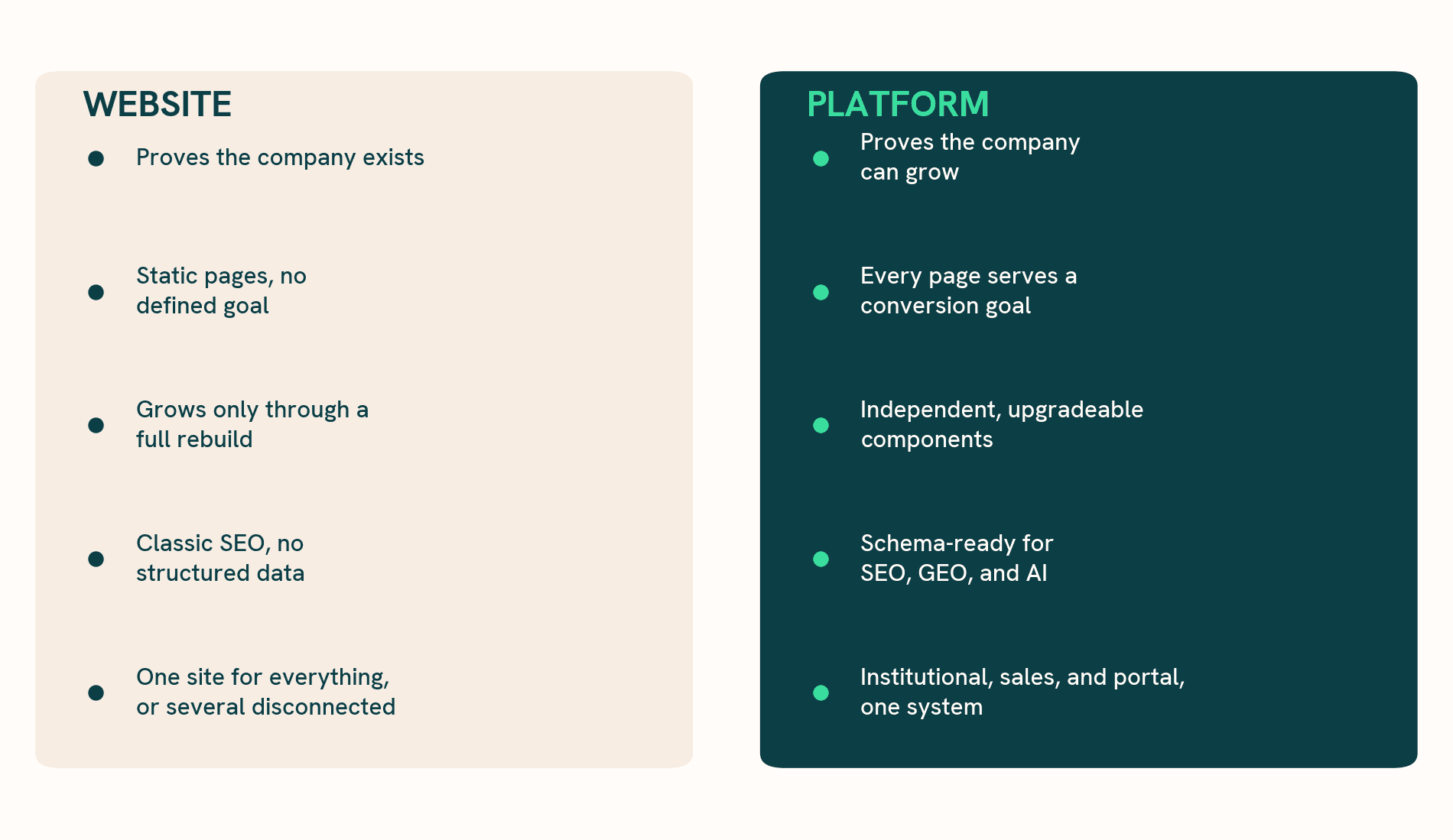
This pattern is consistent: businesses that treat their site as a platform from the start are still running experiments and shipping new segments two years later, while those that treated launch as the finish line are the ones calling back for a rebuild. A composable foundation lets marketing test on its own schedule and lets IT keep architectural control instead of watching a plugin-patched site become unmaintainable one integration at a time. This does not require an enterprise budget on day one; it requires a content model that can be expanded rather than torn out.
That same logic explains why an institutional presence, a sales-oriented flow, and a self-service client or partner portal should generally share one content model, one design system, and one backend, rather than splitting into disconnected sites with inconsistent branding and a backlink profile spread thin across domains. A partner link or a co-marketing page is worth more pointing at a coherent platform than at one more disconnected page competing with the company's own properties for search authority. Conversion has to be designed into the architecture from the start, a form submitted, a demo booked, a ticket resolved, not bolted onto a finished site after the fact.
The Real Decision Is Timing, Not Budget
None of this argues for building the most expensive possible system on day one; plenty of composable, platform-minded builds start lean and add components as the business earns the need for them. What it argues against is treating a first website as a final destination rather than a first phase, because that is the decision behind the 523-day recovery windows and the rebuilds that cost more than doing it right the first time would have. Before choosing a CMS or a development partner, a marketing or IT lead should be able to name what the platform needs to support in the next two or three phases of the business, not just at launch, and pick a foundation that can absorb that growth without being torn out. The real cost of a website is never the invoice for building it. It is the invoice for outgrowing it, and that bill always comes due for the companies that never planned to pay it.
Sources
- Search Engine Journal, “How Long Should An SEO Migration Take? [Study Updated]” (2025)
- Gartner, “Gartner Predicts Search Engine Volume Will Drop 25% by 2026, Due to AI Chatbots and Other Virtual Agents” (2024)
- Builder.io, citing Gartner's 2025 Critical Capabilities for Digital Experience Platforms report
Tags
Services used
Author

Managing Director & Head of Marketing and Sales
Gonçalo Pinheiro brings over 20 years of experience in digital for business. He leads Hypnotic, a web and mobile digital agency, and Yetiman, focused on AI, agents, and AI visibility, alongside a range of other top-tier digital ventures. Always looking for more knowledge.